Bullfrog Goldfield Railroad
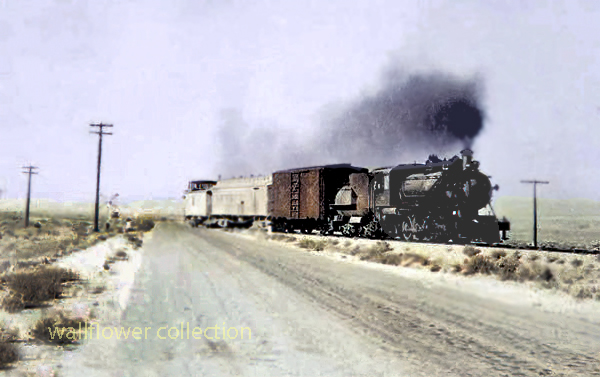
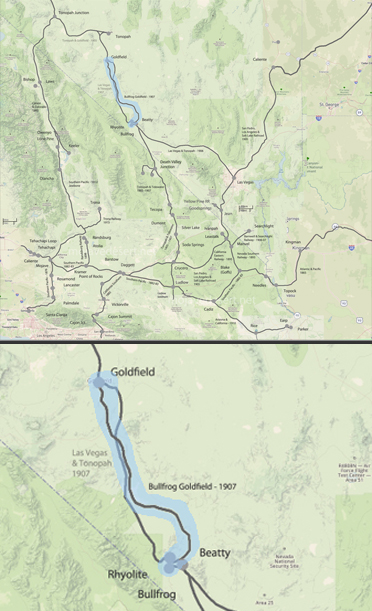
The Bullfrog Goldfield Railroad was a standard-gauge mining railroad built during Nevada's great mining boom of the early twentieth century. It connected Goldfield with Beatty and Rhyolite in the Bullfrog district, carrying ore, mining machinery, lumber, fuel, supplies, mail, and passengers.
The company was incorporated in Nevada on September 1, 1905. Its backers were associated with the Tonopah and Goldfield Railroad and apparently with Tonopah mining interests. The purpose was to give the Beatty and Rhyolite mines a northern outlet through Goldfield and Tonopah, while competing with the Las Vegas and Tonopah Railroad and the Tonopah and Tidewater Railroad.
The Amargosa Construction Company built the line during 1906 and early 1907. It opened in May 1907. The first railroad totaled 81.93 miles:
Rhyolite to Beatty - 7.79 miles
Beatty to Bonnie Claire - 37.49 miles
Bonnie Claire to Goldfield - 36.65 miles
The railroad arrived as the Bullfrog mining boom was already weakening. Rhyolite, Beatty, and the nearby camps had drawn heavy investment and speculation, but the mines did not produce enough long-term traffic to support several competing railroads. The Las Vegas and Tonopah closely paralleled the Bullfrog Goldfield between Beatty and Goldfield, while the Tonopah and Tidewater provided a southern connection to the Santa Fe at Ludlow, California.
On January 1, 1908, the Bullfrog Goldfield and Tonopah and Tidewater began operating as one system. A Delaware holding company, the Tonopah and Tidewater Company, took control of both railroads. The arrangement gave Goldfield and the Bullfrog district a direct route toward the California coast, but it could not overcome the continuing decline in mining traffic.
A reorganization agreement was made in June 1914 and took effect on July 20. The joint arrangement with the Tonopah and Tidewater ended, and the Las Vegas and Tonopah Railroad gained control of the Bullfrog Goldfield through ownership of 51 percent of its stock. The two railroads then operated together, though each remained a separate corporation.
The reorganization eliminated duplicate track. The Bullfrog Goldfield gave the Las Vegas and Tonopah its original Rhyolite-Beatty line and its original Bonnie Claire-Goldfield route. In exchange, it received the Las Vegas and Tonopah's Beatty-Rhyolite branch and its line from Bonnie Claire to Goldfield.
After the exchange, the Bullfrog Goldfield owned 84.78 miles of track: 78.95 miles from Beatty to Goldfield and a 5.83-mile branch from Beatty to Rhyolite.
The Las Vegas and Tonopah ceased operation in 1918. The Bullfrog Goldfield again operated in connection with the Tonopah and Tidewater, serving the remaining mines and communities along its route. Operations ended in January 1928.
The Bullfrog Goldfield Railroad was one of the principal railroads of the Nevada boom era. It was built for the great expectations of Goldfield, Rhyolite, and the Bullfrog district, but outlasted only a small part of the mining excitement that had brought it into being.
Tonopah and Goldfield Railroad
Las Vegas and Tonopah Railroad
Tonopah and Tidewater Railroad
Bullfrog district
Rhyolite and the Bullfrog gold strike
Francis M. "Borax" Smith
Goldfield
Beatty
Rhyolite
Bonnie Claire
Tonopah
Ludlow, California
Las Vegas
Timeline
August 1904Gold discoveries in the Bullfrog district begin the rush that produces Bullfrog, Rhyolite, Beatty, and nearby camps.
September 1, 1905
The Bullfrog Goldfield Railroad Company is incorporated in Nevada. Its backers are connected with the Tonopah and Goldfield Railroad.
Early 1906
Construction begins under the Amargosa Construction Company.
May 1907
The railroad is completed and opens between Goldfield, Bonnie Claire, Beatty, and Rhyolite.
January 1, 1908
Declining mining traffic leads to a joint operating arrangement with the Tonopah and Tidewater Railroad.
1908-1914
The Bullfrog Goldfield and Tonopah and Tidewater operate under a common holding company, but both struggle with insufficient traffic and financial losses.
June 26, 1914
A reorganization agreement is made with the Las Vegas and Tonopah Railroad. Parallel trackage is to be eliminated and exchanged.
July 20, 1914
The reorganization takes effect. The Bullfrog Goldfield comes under Las Vegas and Tonopah control, though it remains a separate corporation.
1915
ICC surveys record 84.78 route miles: 78.95 miles from Beatty to Goldfield and a 5.83-mile branch from Beatty to Rhyolite.
January 7, 1928
The Bullfrog Goldfield Railroad ends operations and is abandoned.