-.-
Southern Pacific Railroad in the Mojave Desert
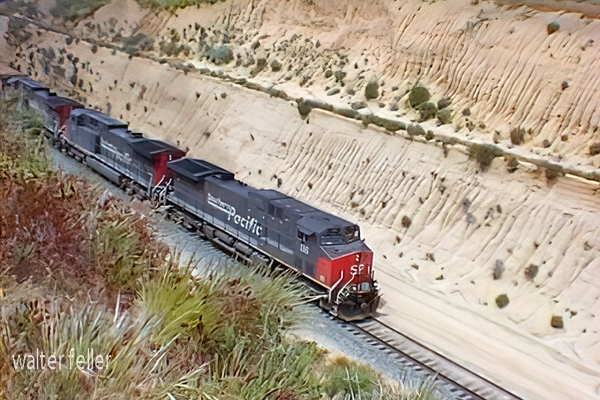
Southern Pacific helped establish the first major railroad route across the central Mojave Desert. Its line from Mojave to Needles connected the Tehachapi route with the Colorado River and created the rail corridor that later became part of the Santa Fe system.[1]
Southern Pacific was chartered in California in 1865 and came under the control of the Central Pacific interests a few years later. In 1876, it completed the line between San Francisco and Los Angeles via the San Joaquin Valley, Tehachapi Pass, and Soledad Canyon.[2]
The Tehachapi route was a major engineering accomplishment. Construction required tunnels, bridges, heavy grading, and a large Chinese labor force. The Tehachapi Loop, completed in 1876, enabled trains to gain elevation on the steep approach between the San Joaquin Valley and the Mojave Desert.[3]
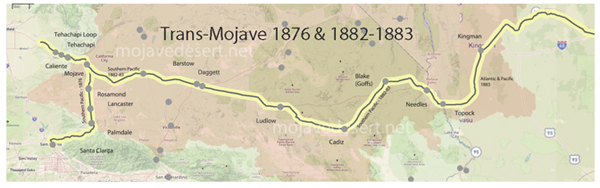
Mojave developed as a railroad construction camp and operating point at the desert side of the pass. From there, Southern Pacific began building east in February 1882 toward Needles on the Colorado River.[4]
Mojave to Needles
Southern Pacific completed the approximately 242-mile line from Mojave to Needles in April 1883. It crossed the central Mojave through Waterman, later Barstow, and passed the developing railroad communities of Daggett, Ludlow, Fenner, and Needles.[4]Southern Pacific built the route in response to the Atlantic & Pacific Railroad, which was advancing west across Arizona under Santa Fe control. Southern Pacific wanted to prevent its rival from building an independent railroad across the Mojave into California. The Atlantic & Pacific reached the Colorado River at Needles in 1883, but Southern Pacific controlled the California-side route westward.[4]
The contest did not end at Needles. The Atlantic & Pacific acquired the Mojave-to-Needles division through an agreement signed on August 20, 1884, and took over operation on October 1. The railroad, therefore, became part of the Atlantic & Pacific and Santa Fe system, even though Southern Pacific had built it.[5]
In 1885, the Santa Fe's California Southern Railroad completed its route through Cajon Pass to Barstow. That connection gave the Santa Fe system a direct route between San Diego, Southern California, Barstow, Needles, and the East.[5]
Railroads and Mining
The trans-Mojave route became the backbone for a larger network of mining railroads and industrial spurs. It connected the desert to outside markets and made it practical to bring in machinery, fuel, timber, and supplies while shipping ore, borax, and other materials outward.Railroads tied the major line to mining districts at Calico, Borate, Randsburg, Ludlow, Providence, Ivanpah, and elsewhere. Some branches survived only as long as the mine or mill they served; others shaped towns that became lasting railroad centers. Vredenburgh and Wilkerson's work is especially useful for placing these railroads within the mining landscape and for identifying the short lines that grew from the main trans-desert corridor.[6]
Legacy
Southern Pacific built the Mojave-to-Needles line, but it did not operate that route into the modern era. The line passed into Atlantic & Pacific and Santa Fe control in 1884. It later became part of the Santa Fe system and today remains an important BNSF freight corridor.[4]Southern Pacific's lasting Mojave legacy is strongest on the Tehachapi route and in the establishment of Mojave as a railroad town. The Mojave-to-Needles line is equally important, but its later history belongs chiefly to the Atlantic & Pacific, Santa Fe, and BNSF.
The Harvey House story belongs with Santa Fe. Needles' El Garces, built in 1908 beside the railroad station, was a Santa Fe hotel, restaurant, and depot, not a Southern Pacific facility.[7]
References
1. Werner, George C. "Southern Pacific System." Handbook of Texas Online, Texas State Historical Association.
2. Graves, J. A. My Seventy Years in California, 1857-1927. Los Angeles, 1927, pp. 98-100.
3. Tehachapi Depot Railroad Museum. "The Engineering Marvel & the Pass, 1875-1876."
4. National Park Service. Mojave National Preserve Administrative History, chapter 2.
5. Lesley, Lewis B. "The Entrance of the Santa Fe Railroad into California." Pacific Historical Review 8, no. 1 (March 1939): 89-96.
6. Wilkerson, Gregg, and Larry M. Vredenburgh. "Railroads and Mining in the Mojave Desert and Southwestern Great Basin, California and Nevada." 2024 Desert Symposium. Use especially the railroad maps and the discussion of mining districts served by the principal lines.
7. BNSF Railway. "A Railroading Oasis." 2023.
Historic RR Chronology
S.P. Jawbone Branch
1876: SAN JOAQUIN VALLEY LINE, SOUTHERN PACIFIC RAILROADThe first railroad in our study area was a segment of the present Antelope Valley Railroad (AVR) which connects Cajon Pass to Palmdale and Mojave. The Tehachapi to Mojave to Palmdale section of this route was originally part of Southern Pacific’s (SP) San Joaquin Valley Line (SJVL) which connected Sacramento to the San Fernando Valley at Lang station. That railroad was built 1875 to 1886 and connected Bakersfield (Summit) to Los Angeles via Tehachapi, Mojave, Lancaster, Palmdale, Soledad Canyon and the San Fernando Valley (Serpico, 2000”1-2). This segment of the SJVL was not made for any particular mining destination. But it did provide easy access to the mines of the Mojave District including the Golden Queen (1876) and Portland Cement (1955) mines.
The SJVL reached Tehachapi, Mojave, Lexin (Ansel) and Lancaster in 1876. From Lancaster the SJVL went south to Palmdale, Harold and Vincent in Soledad Canyon. The SJVL then left the Mojave Desert and went through the San Gabriel Mountains to Newhall where a tunnel connected the line into the San Fernando Valley and Los Angeles. The line was completed at Lang on September 5, 1876 (Serpico, 2000:12-15). This segment of the SJVL is still operated by the SP.
(Wilkerson - Vredenburg)
Railroad History in the Mojave Preserve
That railroad was never built, but the Southern Pacific constructed a line through the desert in 1882-83, from Mojave to Needles, largely along ...
Mojave, CA
Mojave began in 1876 as a construction camp on the Southern Pacific Railroad. From 1884 to 1889, the town was the western terminus of the 165-mile (266 km), ...
Rosamond, CA
Rosamond was originally established in 1877 as a townsite which was owned by the Southern Pacific Railroad and was named 'Rosamond' after the daughter of ...
Lancaster CA
The Southern Pacific Railroad built a line from San Francisco to Los Angeles which was completed in 1876. Along the line was a water stop located in what is ...
Tehachapi Loop
Caliente, CA
Caliente, formerly Allen's Camp was renamed when the Southern Pacific Railroad established construction headquarters here in 1878 while track was laid over ...
Death Valley in '49
The low mountains as those seen in the northwest direction is the same place now crossed by the Southern Pacific Railroad, and known as the Tehachipi pass, ...
History of Antelope Valley
... along its foothills after Fremont's visit and were the preferred way of travel for colonists before the coming of the Southern Pacific railroad in 1876. ...
Railroads in the Mojave Desert
To the south, they extended rails first to San Francisco Bay, and then incorporated the Southern Pacific Railroad to try to replicate their Central Pacific ...
History of the Eastern Mojave
Newspapers in southern California whipped the citizenry into a fury, ... until the Southern Pacific / Atlantic & Pacific Railroad was completed in 1883. ...
Chemehuevis at Twentynine Palms
The situation became especially desperate for the Indians when the Southern Pacific Railroad Company, which had been granted alternate sections of land on ...
El Paso Mining District
With the railroad complete more efficient mills were within reach and the small ... In 1911 the track laying crews of the Southern Pacific briefly camped at ...